


What Is Fashion Week Worth? Inside the Economics of a Global Fashion Capital
Updated: Oct 8
A runway show can end before dinner. Its economic footprint starts weeks or months earlier, and its effects may last longer than the calendar. A fashion week concentrates buyers, journalists, stylists, models, producers, photographers, executives and clients. Their activity reaches hotels, restaurants, transport, studios, galleries, showrooms and stores. The garments anchor a much wider temporary economy.
This does not mean that every participant gains equally. A host city, a luxury house, a production supplier and an emerging label may all describe the same week as successful while measuring entirely different things. That tension is the real economic story.

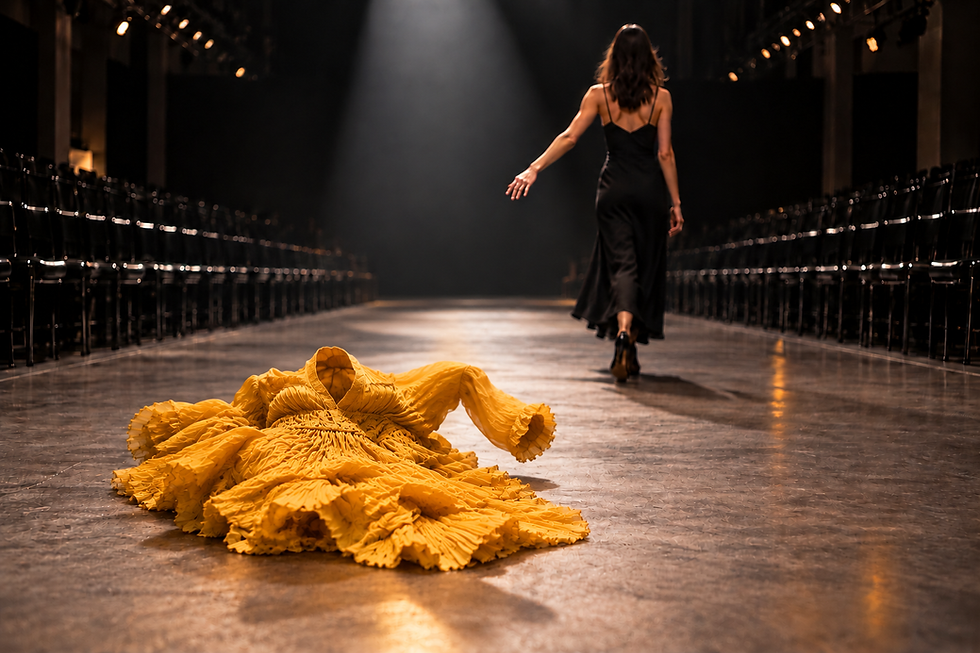
Conceptual editorial image created for NEXT UP; it does not document a specific Fashion Week event.
Four different ledgers
First is direct visitor spending: accommodation, dining, mobility and local services. Second is event production: venue hire, set building, casting, lighting, security, communications and image making. Third is trade activity: showroom appointments, wholesale orders, partnerships and professional introductions. Fourth is media and cultural value: the attention attached to a city, house or designer after the guests leave. These ledgers overlap, but they should not be collapsed into one impressive-sounding number.
YesMilano presents Fashion Week as a citywide calendar with more than 200 events in the edition cited. On the same page, however, the published €250 million economic-impact estimate refers to Milan Design Week, not Fashion Week. The distinction matters: figures from different events, editions and methodologies should not be treated as interchangeable. For a current analysis, the more useful question is how value is distributed and how much remains in local businesses and the fashion supply chain.

Conceptual editorial image created for NEXT UP; it does not document a specific Fashion Week event.
The brand's return is a different calculation
For a large house, a show can combine a trade presentation, a global media campaign and a client experience. Its production cost may be justified through several objectives over time. An independent designer has a narrower margin for error. Samples, travel, casting, production and PR may be paid long before any order is confirmed. Press coverage cannot pay a manufacturer on its own.
A useful decision starts before the invitation list: what is this event meant to change? If the objective is wholesale, count relevant buyers and subsequent orders. If it is positioning, assess whether the people who matter understood and remembered the collection. If it is client acquisition, follow qualified enquiries rather than total impressions. A smaller showroom presentation can be the better investment when it produces the intended outcome.
Attention is valuable only when it converts
Digital channels extend a show beyond its seats. They also make the week crowded: many brands publish at once, and the life of a striking image can be brief. Reach should be separated from recall, useful contacts and commercial conversion. A clip seen widely may build awareness; a handful of durable relationships may build a business. Both are possible, but neither follows automatically from staging a show.
A fashion capital has its own long horizon. It can use the week to strengthen professional infrastructure, connect emerging talent to production, and give visitors reasons to return for commerce and culture. The city's gain and a brand's gain are related, yet they are not interchangeable. Asking who captures the value makes Fashion Week more than a spectacle with an economic headline.
Sources and method
Camera Nazionale della Moda Italiana, SS27 calendar and event types: https://milanofashionweek.cameramoda.it/en/calendar . YesMilano, fashion and design events and historical impact context: https://www.yesmilano.it/en/invest-startup/fashiondesign/events . The four-ledger framework and the recommendations for designers are NextUp's analysis.


Comments